The DBL(Database of Byzantine Literati) maps significant instances of rhetorical performance and the social networks attested around such performances, as well as the social and spatial mobility of Byzantine literati from the eighth and the middle of the fourteenth centuries.
The DBL is a meta-prosopography that relies on data available from PmbZ, PBW and PLP (among others), as well as original sourcing directly from medieval Greek texts. The database currently includes handpicked case studies of rhetorical performances (mainly, verse or prose letters, orations, and epigrams) dating from the tenth and twelfth centuries. For a detailed record of the sources searched and entered systematically into the database, please refer to References. Given the volume of the undertaking, the currently available data are by no means complete, and the material is constantly expanded and updated. If you are interested in contributing to the DBL or you have comments/corrections please don't hesitate to contact us.
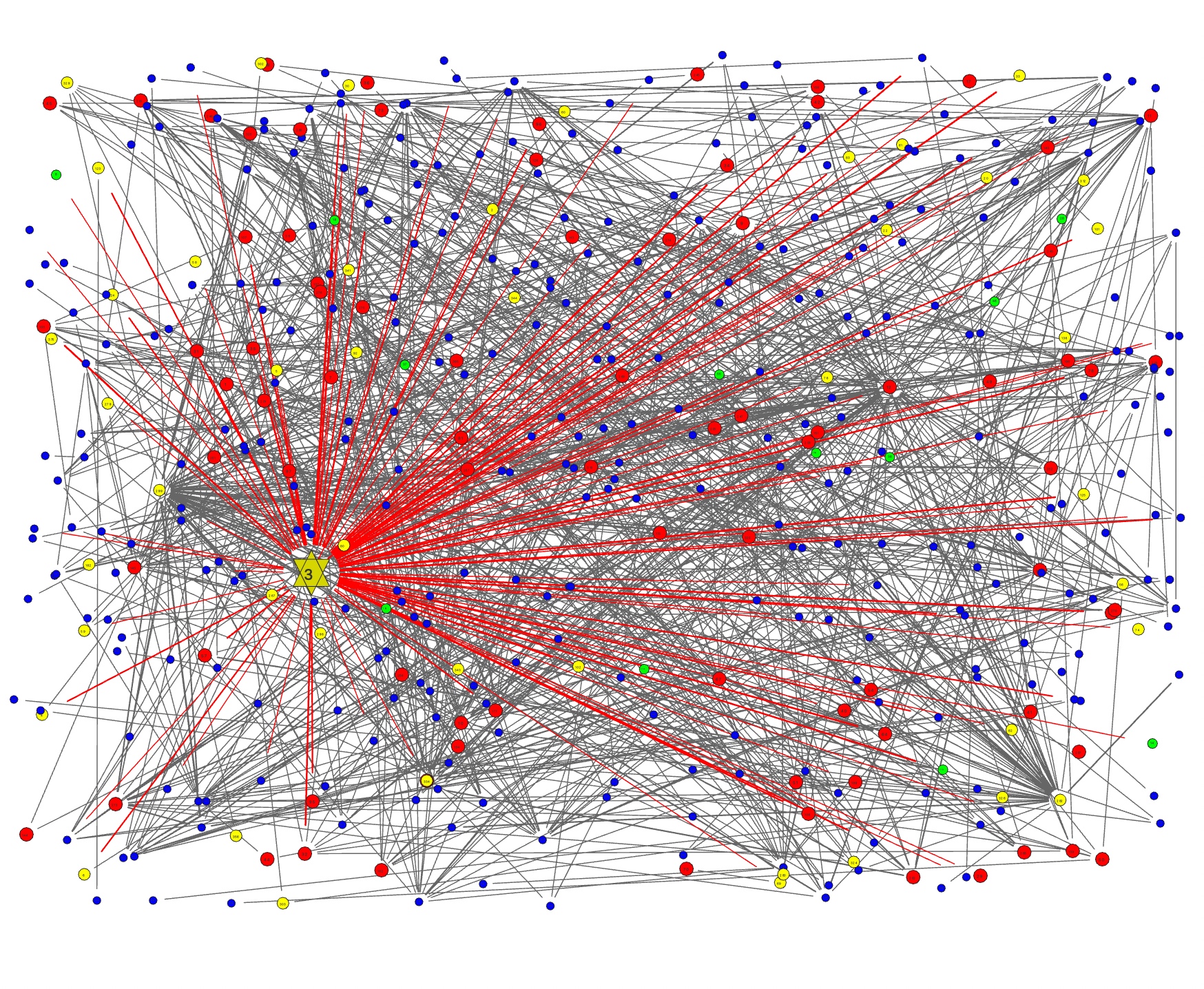
Network of Ioannes Tzetzes (ID 1014), visualised with SocNetV
Users can perform searches based on Actors (All Actors/Literati), Performances, and Locations. Individuals participating in the literary production (as producers, instigators, or recipients) and the relevant social and family networks of their time are defined as actorsand they are assigned a unique ID number (top left of the page). The tab for each actor includes a cross-reference to prosopographical registers, the list of their affiliations, as well as the list of the rhetorical performances they were involved in, as these are entered in the DBL. For a chosen minority of literati, details about individual career trajectories are also available. We hope to expand this feature in the near future. A map to be found at the bottom of the page visualises an actor's family origins, mobility at different career stages and the locations of related performances. Rhetorical and other written documents destined to be pronounced before audiences of various sizes are defined here as performances. Users can find details about a text's format, attestation, publicity level, date and place of the performance (if known). Finally, users can browse for locationsand their associated actors and performances.
Among the innovative features of the DBL is the freedom that it gives its users to browse and export relational data in forms, available for further modification and/or visualisation. Under "Network" users can choose to export single or double ego networks, which can be subsequently visualised using open-source network visualisation tools, such as GEPHI (GEXF) or SocNetV (GRAPHML), or export excel files (CSV) and weighted edge lists (in .txt). The GEDCOM format should only be used for the visualisation fo family relations. Actors are identified with both their name and their unique DBL ID number. Currently, the generated networks include also actors with "Null Affiliations". Users are strongly advised to clean the data by either choosing specific types of affiliation between actors (an option given at the bottom of the page) or by data modification in the preferred programme (e.g. GEPHI).